
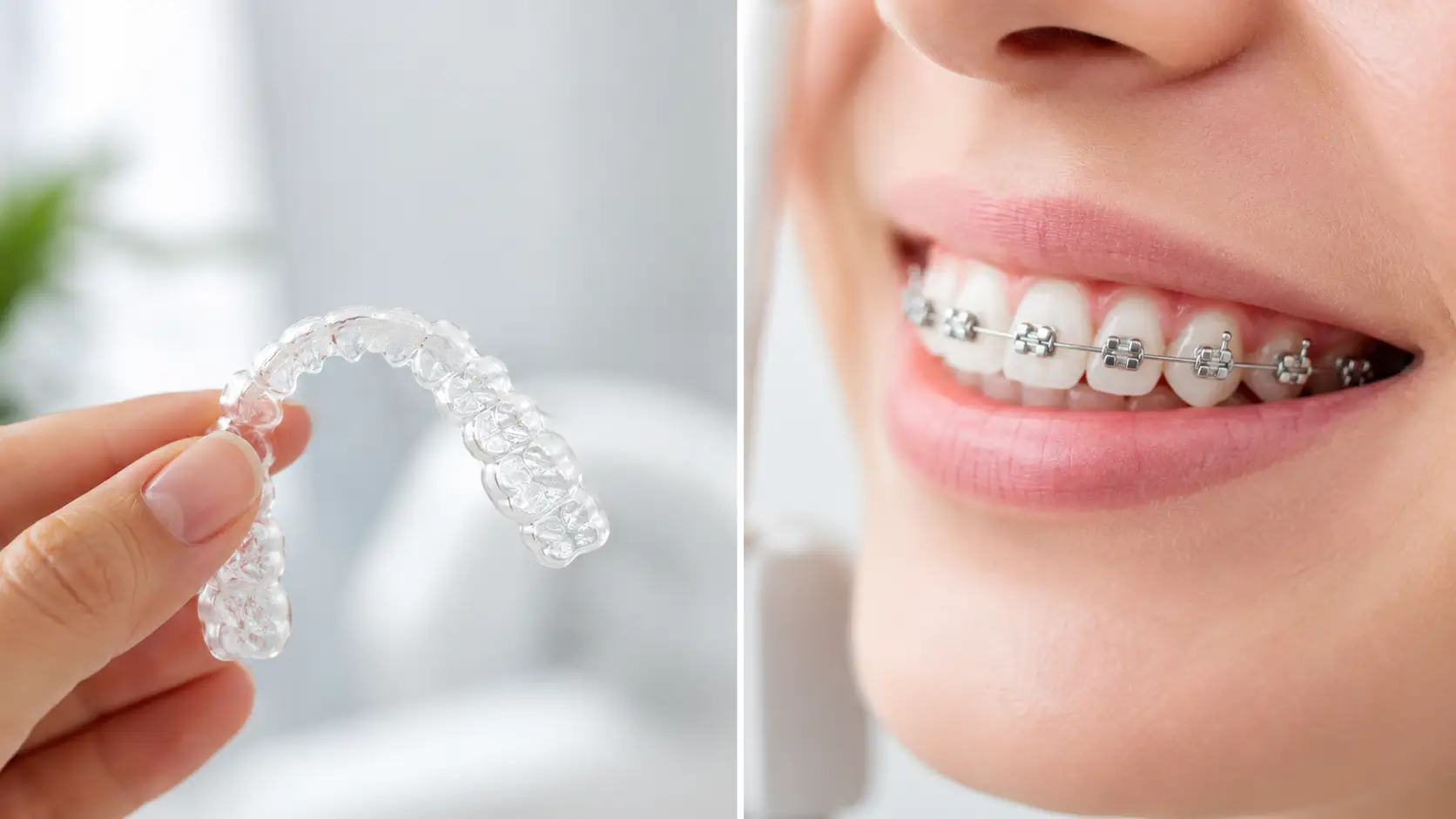
Clear aligners vs fixed braces comparison at Limes Dental Practice Gloucester
If you are thinking about straightening your teeth as an adult, you have likely come across two main options: clear aligners and traditional fixed braces. Both move teeth into a better position. Beyond that, they are quite different — in how they look, how they feel, how long treatment takes, and which cases they are best suited to.
This guide walks through the key differences so you can go into a consultation with a clearer idea of what to expect from each.
Both treatments apply controlled pressure to move teeth gradually into position — but they do it differently.
Fixed braces use metal or ceramic brackets bonded directly to your teeth, connected by a wire that your dentist tightens at regular intervals. The wire is what generates the force to move teeth. Because they are fixed in place, they are working constantly.
Clear aligners are a series of custom-made plastic trays worn over the teeth. Each tray is slightly different from the last, and by progressing through the series — typically changing trays every one to two weeks — your teeth move incrementally toward the target position. They need to be worn for 20 to 22 hours a day to be effective.
The mechanical outcome — straighter teeth — is the same. The path to get there is different.
This is the most obvious difference for most adults considering treatment.
Fixed metal braces are visible. Ceramic braces use tooth-coloured brackets which are less noticeable, but the wire running between them is still visible. For many adults, particularly those in professional or client-facing roles, this is a significant consideration.
Clear aligners are virtually invisible. Most people wearing them will not be noticed unless someone is looking very closely. For adults who have put off teeth straightening specifically because of how braces look, this is often the deciding factor.
Fixed braces involve brackets and wires that sit against the soft tissue inside your mouth. It is common to experience soreness after tightening appointments, and the hardware can occasionally cause irritation to the cheeks and lips.
Clear aligners are made from smooth plastic with no sharp edges. There is typically some pressure when you move to a new tray — a sign the aligners are working — but most patients find this settles within a day or two. There are no tightening appointments and no brackets to catch on soft tissue.
For most patients, clear aligners are the more comfortable option day to day.
With fixed braces, there is a list of foods to avoid — anything hard, sticky, or chewy that could damage the brackets or get caught in the wire. Popcorn, chewing gum, hard sweets, crusty bread, apples — all off the menu for the duration of treatment.
Clear aligners are removed before eating and drinking anything other than water. This means there are no food restrictions at all. The trade-off is that you need to brush your teeth before reinserting the aligners after meals, which takes some adjustment — particularly if you are used to eating on the go.
Keeping teeth clean around fixed braces requires more effort. The brackets and wires create additional surfaces for plaque to accumulate, and flossing requires special tools or techniques. Research published on PubMed shows that white spot lesions — early signs of enamel demineralisation — are a recognised and common complication during fixed brace treatment when oral hygiene is not carefully maintained.
Clear aligners are removed for brushing and flossing, so your routine stays essentially the same as before treatment. This is a meaningful advantage for patients who want to maintain good oral health throughout.
This is where the honest answer matters most.
Clear aligners work well for mild to moderate cases — crowding, spacing, minor bite issues, and teeth that need straightening within a limited range of movement. Technology has improved significantly, and modern clear aligners can address more cases than earlier generations could. For many adults, they are clinically appropriate.
Fixed braces remain the more versatile option for complex orthodontic cases. Significant overcrowding, larger bite corrections, rotations of certain teeth, and cases requiring precise three-dimensional control may still be better suited to fixed appliances.
If you are a suitable candidate for clear aligners, there is rarely a clinical reason to prefer fixed braces. If your case is complex, your dentist will tell you.
Both treatments take roughly similar amounts of time for comparable cases — typically between 10 and 24 months, depending on the complexity of the work required.
Clear aligner treatment can sometimes be shorter for mild cases. Fixed braces may achieve certain movements more efficiently in complex cases. The honest answer is that duration depends primarily on what your teeth need to do, not which appliance you choose.
The cost of either treatment varies depending on the complexity of the case and the provider. Broadly speaking, clear aligners from a dental practice are often comparable in cost to ceramic fixed braces — and in some cases more affordable than branded aligner systems like Invisalign.
At Limes Dental Practice, we offer custom clear aligner treatment with flexible finance options. The right starting point is a consultation where we can assess your case and give you an accurate cost.
For most adults with mild to moderate alignment concerns, clear aligners offer a more comfortable, more discreet, and equally effective route to straighter teeth. The removability alone makes a meaningful difference to daily life over a treatment period of one to two years.
Fixed braces remain the stronger option for more complex orthodontic needs — but if your case is straightforward, there is rarely a reason to choose them over clear aligners on clinical grounds.
The most important step is a proper assessment. Photographs and digital scans taken at a consultation give your dentist the information needed to tell you honestly which option is appropriate for your specific teeth — and what results you can realistically expect.
At The Limes Dental Practice in Gloucester, we offer custom clear aligner treatment for adults and teens with mild to moderate alignment concerns. Treatment is planned digitally, so you can see how your teeth are expected to move before committing. Flexible finance is available.
We see patients from across Gloucester, Cheltenham, Stroud, Churchdown, Quedgeley, and the wider Gloucestershire area.
Book a clear aligner consultation at Limes Dental Practice →
Reviewed by Dr Andrew Connolly, BDS MSc Implant Dent, Principal Dentist at The Limes Dental Practice.