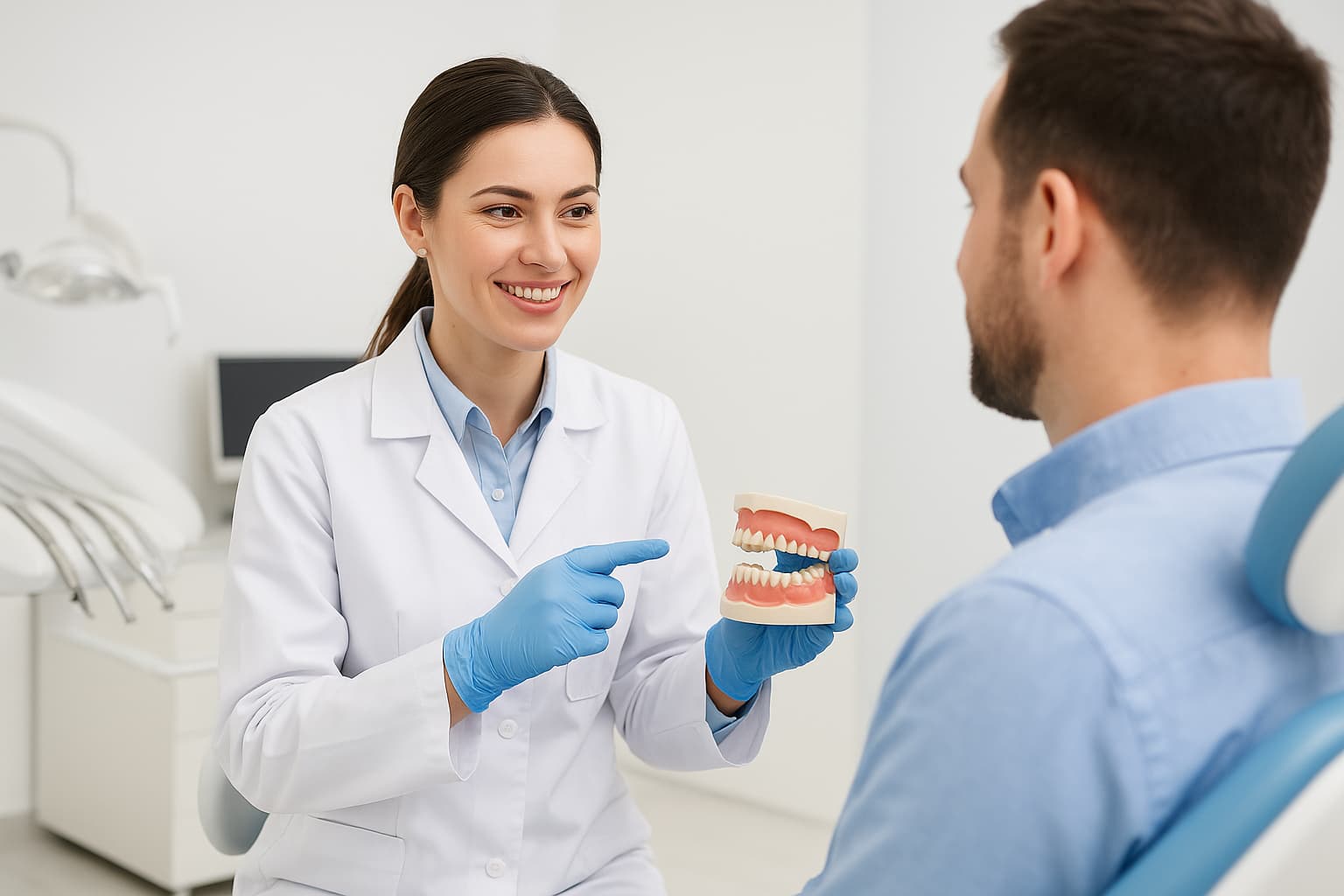
If you are missing most or all of your teeth, or struggling with dentures that shift, slip, or make eating uncomfortable, full arch dental implants could offer a more permanent, stable solution.
Full arch dental implants replace an entire upper or lower set of teeth using a small number of implants placed in the jaw, which then support a fixed set of replacement teeth. Unlike removable dentures, they stay in place. Unlike a dental bridge, they do not rely on neighbouring teeth for support.
You may have come across the term "All-on-4" while researching your options. This is one well-known approach to full arch implant treatment, but full arch implants is the broader category, and the number of implants used, as well as the type of restoration, will depend on your individual clinical needs.
At The Limes Dental Practice in Gloucester, Dr Andrew Connolly, who holds a Master's degree in Implant Dentistry, offers full arch implant-supported treatment as part of a comprehensive range of implant services.
Full arch dental implants are a fixed tooth replacement solution for patients who have lost most or all of their teeth in one or both jaws.
The treatment works by placing multiple titanium implants directly into the jawbone. Once the implants have fused with the bone, a process called osseointegration, they provide a secure foundation for a full arch of replacement teeth. These replacement teeth can be either fixed in place or, in some cases, removable but implant-retained for added stability.
The result is a set of teeth that look, feel, and function closely to natural teeth. Patients can eat normally, speak confidently, and maintain oral hygiene without the compromises that come with traditional removable dentures.

You may have seen "All-on-4" mentioned frequently online. It is a specific treatment concept where four implants are placed in strategic positions to support a full arch of teeth, often with the rear implants angled to maximise contact with available bone.
Full arch implants is the broader term. Depending on your bone density, jaw structure, and clinical requirements, your treatment plan may involve four implants, six implants, or more. Some patients also require preparatory treatment such as bone augmentation or a sinus lift before implants can be placed.
The number of implants is not the defining factor. What matters is that the implants provide a stable, long-term foundation for your replacement teeth and that the treatment plan is designed around your specific anatomy and goals.
For patients who have worn removable dentures for some time, the differences are significant. If you would like to explore how these two options compare in more depth, our guide to dental implants vs dentures covers the key considerations in detail.
One consideration that is often overlooked is bone preservation. When teeth are lost, the jawbone beneath them gradually resorbs over time. Removable dentures do not address this. Implants do, because the titanium post stimulates the bone in the same way a natural tooth root would.
Full arch implants are suitable for a wide range of patients, but a thorough consultation and clinical assessment are always required first.
Patients who may be suitable include those who are missing most or all of their teeth in one or both jaws, those who are struggling with loose or uncomfortable dentures, those who find certain foods difficult or impossible to eat, and those who want a long-term fixed solution rather than a removable appliance.
There are also factors that may affect suitability or require additional treatment beforehand. These include reduced bone volume in the jaw, a history of gum disease, smoking, and certain medical conditions. None of these automatically rule out treatment, but they do need to be assessed carefully.
This is why a consultation, including detailed scans, is an essential first step rather than an optional one.
For a full arch, treatment typically involves between four and six implants per jaw. The exact number depends on the quality and volume of bone available, the type of restoration being placed, and the clinical judgment of the implant dentist.
Some patients have sufficient bone for straightforward implant placement. Others may need bone augmentation, where bone volume is built up before or at the time of implant placement, or a sinus lift, which creates space in the upper jaw for implants where the sinus sits close to the bone. Both procedures are available at Limes Dental Practice.
Full arch implant treatment takes place over several months. This is not a reflection of complexity so much as biology; the implants need time to integrate with the jawbone before the final restoration can be fitted. Our guide to what to expect from the implant process walks through each stage in detail.
Consultation and scans. The process begins with a detailed assessment including X-rays and, in most cases, a CBCT cone beam scan. This gives a precise picture of bone volume, nerve positions, and sinus anatomy. Dr Connolly will use this to design your individual treatment plan.
Implant placement. The implants are placed under local anaesthetic. Most patients find the procedure more comfortable than they expected. Temporary replacement teeth are provided so you are not without teeth during the healing period.
Healing and osseointegration. Over the following months, the implants fuse with the jawbone. This stage is critical to the long-term stability of the treatment. You will be seen for follow-up appointments throughout.
Final restoration. Once the implants have fully integrated, the final arch of replacement teeth is fitted. Adjustments are made to ensure comfort, function, and appearance meet expectations.
Aftercare. Implant-supported teeth require regular hygiene appointments and check-ups, just like natural teeth. Long-term success depends significantly on maintenance.
The cost of full arch implant treatment depends on several factors: the number of implants required, whether preparatory treatment such as bone augmentation or a sinus lift is needed, and the type of restoration chosen.
At Limes Dental Practice, implant placement starts from £995 per implant, and implant crowns from £895. Where bone augmentation is required, this starts from £550; sinus lift from £995.
Because full arch treatment involves multiple implants and a bespoke restoration, the total investment is specific to each patient's case. A full breakdown and treatment plan is provided following your consultation, before any commitment is made.
Limes Dental Practice is based on Stroud Road in Gloucester, with convenient access for patients travelling from Cheltenham, Stroud, Churchdown, Quedgeley, Stonehouse, and across Gloucestershire.
Dr Andrew Connolly, BDS MSc Implant Dent, has been placing implants at the practice for many years. His postgraduate qualification in implant dentistry reflects a level of specialist training that goes beyond general dental practice, which matters when the treatment you are considering involves surgery and a long-term commitment.
If you have been living with missing teeth or uncomfortable dentures and want to understand whether full arch implants could work for you, the right first step is a consultation. You may also find it useful to read about what to expect from dental implant surgery before booking.
Book a dental implant consultation at Limes Dental Practice
Reviewed by Dr Andrew Connolly, BDS MSc Implant Dent, Principal Dentist at The Limes Dental Practice.